We follow water-sensitive urban design principles and environmental best practices
To align with contemporary urban water management principles, as well as state and local government strategic planning, Griffith adopts a water-sensitive urban design approach to campus operations. This ensures we reduce our consumption through efficient water use, which has a range of health, environmental, social, and economic benefits. Water sensitive design provides cooler campuses, reduces flood risk, improves air quality, allows staff and students to connect with nature, and prevents polluted water entering the water system, including pollution caused by accidents and incidents at the University.


Sustainable Development Goals
Griffith University is aligned to the United Nation's Sustainable Development Goals (SDGs) and is committed to ensuring clean water and sanitation, affordable and clean energy, and the preservation of marine life, working towards a sustainable and environmentally responsible future.
Our Approach
Water Consumption Tracking
Griffith University tracks treated water usage across all campuses to understand consumption, identify leaks and highlight opportunities to improve efficiencies. During the Millennium drought (1997–2009), the University implemented water saving measures across all campuses, including waterless urinals and water-saving taps.
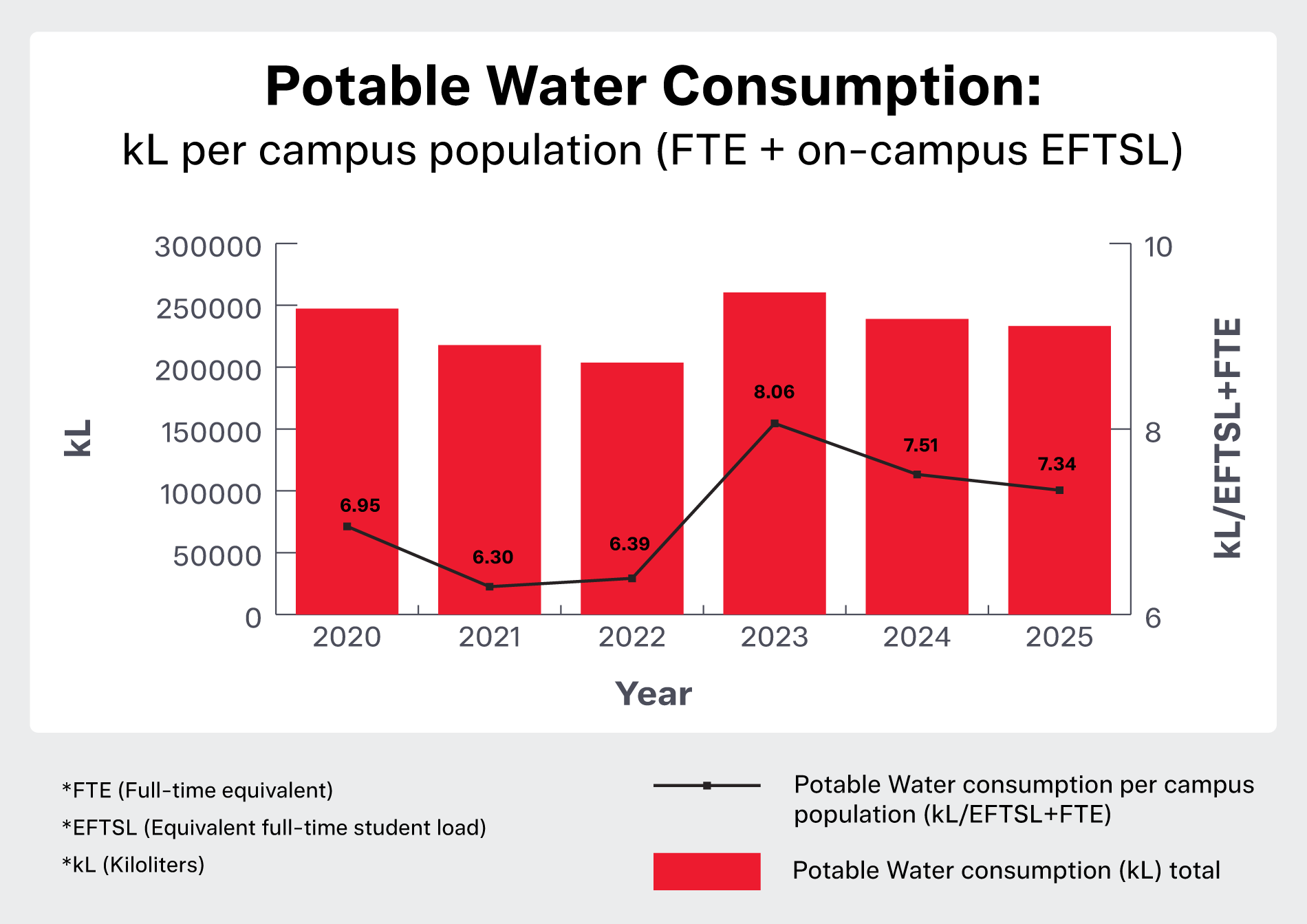
In 2025, total water consumption was 233,217 kilolitres (kL) , of which 232,446 kilolitres (kL) came from mains water, based on water utility data, and 771 kL came from water extracted on Logan (which is used to irrigate green space and sporting facilities). In 2025, he total water use equates to 20.1 L per person per day, a reduction from 20.6L per person per day in 2024.
Water consumption per staff and student
The university tracks treated water consumption by staff and students (both full-time equivalent and equivalent full-time student load).
Total treated water (mains supply) consumption and consumption change for FTE and EFTSL across all campuses from 2017-2025:
| 2020 | 2021 | 2022 | 2023 | 2024 | 2025 | |
|---|---|---|---|---|---|---|
| Potable Water consumption ( kL ) total | 247,260 | 217,837 | 203,645 | 260,394 | 238,945 | 233,217 |
| Potable Water consumption per campus population ( kL / EFTSL + FTE ) | 6.95 | 6.30 | 6.39 | 8.06 | 7.51 | 7.34 |
Explore campus-wide data on water usage through interactive dashboards designed for easy navigation and detailed insights:
Total treated water (mains supply) consumption across all campuses from 2020-2026.
Wastewater Treatment
Providers
Griffith University uses local council wastewater treatment processes and facilities to treat wastewater across all campuses.
The Queensland Department of Natural Resources advises local governments on the management and maintenance of sewerage systems and treatment plants, and local councils are licensed under the Environmental Protection Act 1994 to discharge wastewater that has been treated and meets an acceptable environmental standard.
Providers for wastewater treatment for Griffith University include:
- Urban Utilities for our campuses - Brisbane South (Nathan) and Brisbane City (South Bank),
- Logan City Council for the Logan campus and
- Gold Coast City Council for the Gold Coast campus.
Griffith measures the volume of water that is reused as a result of ‘wastewater treatment’. In 2025, ∼ 186,574 m3 of wastewater (including both grey and black water) was treated by Urban Utilities, Logan City Council and Gold Coast City Council. Queensland Urban Utilities also utilises advanced reservoir osmosis and microfiltration of treated wastewater to return this water to the grid.
Since the Millennium drought (1997–2009) Griffith University has partnered with local councils and state governments to ensure water security and improve water management. These partnerships included Griffith's involvement in the Urban Water Security Research Alliance, the largest urban water research program in Australia at the time. Research from this partnership has provided a foundation for the reform of South East Queensland water management, including new water grid infrastructure and a desalination plant.
Standards
Upgrades to wastewater treatment operations in South East Queensland during and since the Millennium drought means South East Queensland now delivers some of the highest-quality drinking water in the world. Wastewater is cleaned and treated at water treatment plants to the stringent standards set by the Australian Drinking Water Quality Guidelines and returned to the water grid.
This world-leading wastewater treatment, combined with the widespread adoption of water-sensitive urban design measures (i.e. rainwater tanks, permeable pavements and stormwater harvesting) has meant Griffith University has contributed to, and uses, wastewater treatment networks that provide water security to South East Queensland, while minimising environmental impacts.
Promoting water quality standards and preventing pollution
Preventing water system pollution
To prevent physical, biological and chemical alterations to the unique aquatic ecosystems on and around our campuses, including pollution caused by accidents and incidents at the university, Griffith has established processes to minimise and prevent water system pollution by promoting water quality through:
Comprehensive contaminant management and response processes:
Griffith University’s Design Guidelines (updated in 2024) set a suite of regulatory control measures for internal operations and external contractors in line with the Environmental Protection Regulation 2019 and the Environmental Protection Act 1994 to prevent pollution from contaminated water release. For large projects, contractors must prepare a Construction Safety and Environment Management Plan that describe how environmental risks will be managed, what control measures will be used and how their effectiveness will be monitored and reviewed. Compliance of Environmental Health and Safety (EHS) plans, including incident monitoring and notification processes, is managed by contractors and supporting safety teams in collaboration with Griffith’s Major Projects and Capital Works and Minor Projects teams. This includes on-site EHS officers and regular inspections by a site superintendent. Griffith University also requires that contractors undertaking high risk work, as part of minor works construction, maintenance or services, provide an appropriate safety plan or Work Method Statement, describing how the risks will be controlled before starting work. Additional contaminated water management controls include:
- water from air-conditioners to sewer/trade waste and not stormwater
- floor drains not provided under laboratory safety showers to prevent unwanted contaminants leaving the lab space.
Initiatives to prevent plastic contamination:
Our Design Guidelines contain requirements for stormwater management approaches that aim to prevent or significantly minimise pollution and erosion. The requirements include:
- Use biologically based stormwater management features such as swales, sediment control ponds, pools and wetlands along drainage courses, and infiltration basins to retain and treat stormwater onsite.
- Minimise landscapes and use permeable paving and surface materials to maximise site water absorption.
- Ensure runoff is directed away from buildings.
- Install stormwater filters and debris separators.
- Use of silt control barriers to prevent contamination of stormwater drains and streams.
Griffith has developed water quality standards and guidelines for water discharges, to uphold water quality and protect ecosystems, wildlife and human health and welfare:
We worked with students and Griffith experts to develop an informed and appropriate protocol for the ecological monitoring of sensitive water bodies at Gold Coast, Logan and Brisbane South (Nathan). The protocol includes information on monitoring locations, parameters (e.g. biological, physico-chemical), timing, and people responsible. This work was completed and monitoring initiated in late 2025.
Griffith University undertakes real-time monitoring of aquatic ecosystem health across sensitive water bodies associated with its Gold Coast, Logan and Brisbane South (Nathan) campuses. Through a partnership with TracWater Pty Ltd (OzGreen Energy trading as TracWater), floating buoy monitoring systems have been deployed within campus waterways, including both lakes at the Logan campus and waterways at the Gold Coast and Brisbane South (Nathan) campuses.
Learn more Waterway Monitoring Protocol
The development of erosion and sediment control processes:
We worked with students and Griffith experts to develop informed and appropriate procedures for proactive erosion monitoring and management, along with incident notification processes. The protocol ensure compliance with environmental regulations and standards and reduce pollution (sediment, contaminants, rubbish, micro-plastics) into waterways on campuses and into downstream water bodies. This work was completed and erosion audits initiated in mid-2025.
Erosion and Sediment Management Protocol
Management of all potential hazardous materials, chemicals and pollutants on campus in accordance with Australian standards:
The University has a legal obligation under the Work Health and Safety Act 2011 to control hazards and risks associated with hazardous chemicals within the workplace. In addition, the University must comply with the requirements of the Environmental Protection Regulation 2019 regarding the disposal of regulated waste. The University has policy, standards and procedures related to the management and handling of chemicals including Guidelines for the Management of Clinical and Related Waste, Standards for Managing Chemicals, and a Policy for Handling, Using and Disposing of Chemicals. This suite of documents ensures the management of all potential hazardous materials, chemicals and pollutants on campus in accordance with Australian standards to prevent polluted water entering the water system, including pollution caused by accidents and incidents at the university.
Risk Assessing Chemicals Guidelines for the Management of Clinical and Related Waste Standards for Managing Chemicals
Handling, Using and Disposing of Chemicals Policy Acquiring and Transferring ChemicalsTransporting Chemicals
Procedure Environmental Sustainability Policy
Our Design Guidelines set requirements to prevent pollution from contaminated water release.
Preventing marine pollution
Griffith University seeks to ensure a sustainable marine environment through improving marine health and preventing marine pollution of all kinds, in particular from land-based activities.
Microplastics entering the fresh and marine aquatic environment are a major environmental and social challenge. Alongside leading research on microplastics within the marine environment, our plastic reduction initiatives include:
- removal of plastic cutlery, utensils and straws from campus service providers and catering
- a Sustainable Event Guide to support the reduction of single-use plastic at Griffith events and graduation ceremonies
- KeepCup and bring-your-own-water-bottle campaigns to encourage reuse and limit the sale of single-use plastic drink containers
- water fountains and refill stations to encourage the use of reusable containers and ensure access to clean drinking water for all
- development of waste management plans to avoid and limit plastic waste as Griffith strives to become a zero-plastic university.
Construction and maintenance works associated with campus development has the potential to cause erosion, releasing sediment into the natural environment. Griffith University is developing measures to monitor and control sediment erosion across our campuses. These measures are informed by our Precision Erosion and Sediment Management Research Group, which develops timely, cost-effective strategies to precisely define and manage erosion and sediment sources in our waterways and catchments.
Free drinking water
As at 2025, we have over 200 drinking water fountains across our campuses, as well as filtered hot and cold water in student and staff kitchen areas to provide free drinking water to all students, staff and visitors.
The Accessing Free Drinking Water on Campus Guide provides maps with detailed information on drinking water locations. This guide also outlines the benefits of refilling and reusing water bottles to prevent waste and plastic pollution entering aquatic and terrestrial environments.
Griffith has mandated the continued provision of free drinking water to staff & students under section 3.2 of the Environmental Sustainability Policy.
Accessing free drinking water on campus guide Environmental Sustainability Policy
Water reuse policy and measurement
Rainwater and water reuse options across Griffith Campuses
As per our Environmental Sustainability Policy (created in 2023), Griffith has committed to "Protect and enhance the catchments and marine environments in which the university operates, prevent polluted water entering the water system (including pollution caused by accidents and incidents at the university), maximise water reuse, provide free drinking water, and reduce environmental impacts through use of a best practice process to treat wastewater".
Environmental Sustainability Policy
The university currently measures reuse of water through its rainwater tanks located across its campuses. Water from rainwater tanks on campus is reused for flushing toilets and immediate building green space irrigation.
In 2025, water reuse through rainwater tanks was estimated to be 1 million litres.
This figure is based on the total rainwater tank capacity and assumes that each tank is completely used once during the year with some being used more and some less. For tanks that are solely used for garden irrigation, the use will depend on seasonal variation and weather.
| Campus | Buildings | Rainwater tank capacity (KL) |
|---|---|---|
| Brisbane South (Nathan) | N08, N35, N36, N68, N75, N78, N79 | 80,000 |
| Gold Coast | G02, G09, G11, G16, G26, G31, G33, G34, G39, G42, G51, G52 | 956,055 |
| Logan | L00, L01 | 203,000 |
| Total rainwater tank capacity (estimated) | 1,044,055 | |
Water-conscious building standards
At Griffith, we ensure our buildings are safe, efficient and sustainable following the requirements, policies, regulations and technical guidance set out in our design guidelines.
To reduce potable water consumption across our campuses, all new buildings comply with sustainable standards, including the application of water-conscious building standards outlined in the 2024 Griffith Design Guidelines. These guidelines include the provision of water reuse requirements in accordance with local building and wastewater codes.
Standards include the consideration of water use minimisation measures (e.g. installing waterless urinals and using flow restriction fixtures and reduced water pressure on taps), and of rainwater capture and reuse systems, to maximise water reuse across the University. The guidelines encourage performance exceeding National Construction Code standards and align with Queensland’s energy efficiency requirements.
By incorporating water reuse systems into new construction projects, the University demonstrates its commitment to environmental stewardship, reduces operational costs, and sets a precedent for sustainable development within the community. Griffith Engineering Services and Facilities Management teams conduct periodical reviews of existing rainwater collection and use infrastructure to provide information on operational status, maintenance requirements and use potential.
Water-conscious planting
Griffith University adopts a native vegetation approach to campuses, including:
- a focus on retention and enhancement of remnant vegetation
- campus design and green space management using native vegetation and, if irrigation is required, collecting rainwater for use where possible
- developing nature-based solutions to reduce stormwater velocity and prevent contamination release and erosion, including leveraging vegetated and naturalised flow paths wherever possible
- managing risks posed by bushfires and extreme events, while protecting ecosystem functionality and advantages provided by natural assets
- developing action plans to improve riparian health through weed management and riparian restoration, and ensuring campus development maintains appropriate ecological buffers from any riparian zone.
The university selects Australian native plants for its campuses to minimise water usage, leveraging the drought-tolerant properties of these species to create a sustainable and resilient landscape. You can view and download the lists of native plant species found at our campuses on the Griffith Biodiversity webpage.
The Griffith University Biodiversity Conservation Plan 2022–2025 and its associated Landscape Management Plans include local and native plant palettes designed to minimise and, where possible, eliminate irrigation. This approach ensures we deliver water-conscious planting and plant landscapes that reduce water consumption across our campuses.
As per our design guidelines, preference shall be given to the use of drought tolerant plants which do not require regular watering.
Biodiversity Conservation Plan 2022–2025
Gold Coast Master Plan and Planting Strategy
Recent examples planning and completed across 2025-2026 included work on our Gold Coast Campus where hardy inexpensive native species were planted (mainly Lomandra):
- Erosion management swale works complete near G02 – under the billboard at the Smith St Motorway entrance
- Water sensitive urban design captures water coming from G02 carpark, slows it down, allows more absorption to soil, and diverts excess to stormwater drains.


Sustainable water extraction
Where irrigation of sports fields and green spaces on our campus is required, Griffith University follows the Queensland Government's guidelines on efficient irrigation for water. Griffith Design Guidelines (2024) require sustainable water extraction technologies (e.g. technologies including water meters, centralised controls & rain sensors to minimise use of treated water and extraction) and seek to eliminate the need for landscape irrigation systems through careful plant selection by preferencing native or drought resistant species to minimise the need for artificial irrigation following establishment. Potable water is only supplemented for irrigation when necessary, and subject to weather conditions, internal supervisor approval, relevant water restrictions and permits from local government.
At Logan, water for irrigation is extracted via two interconnected lakes. These provide a range of benefits through:
- sports field irrigation (in-lieu of potable water); these sporting fields provide both the university and local community with access to in-demand, high quality recreational facilities
- providing habitat for a range of local species, supporting ecological services in the catchment
- managing local flood risk for low-lying parts of the campus and downstream communities.
Extracted water from the Logan Lakes are used to irrigate green spaces for approximately 20 minutes on average three times per week, with actual irrigation application responsive to atmospheric conditions to ensure sustainable use. Based on this, average annual irrigation from the lakes responsible is estimated to use up to 771 kilolitres of extracted water to sustainably ensure green space on Logan.
Sustainable food from aquatic ecosystems
Griffith University is committed to mitigating the impact of our operations and supply chains on the climate and the natural environment. The University applies a responsible and purposeful procurement approach that is consistent with Queensland Government priorities and aligns with the University’s sustainability objectives, including the United Nations Sustainable Development Goals (SDGs).When undertaking procurement activities (including food on campus), the university looks to minimise environmental impacts and support resource efficiency across the lifecycle of goods and services, including:
- emissions reduction and transition to low-carbon solutions
- waste minimisation and circular economy principles (e.g., reuse, repair, recycling)
- avoidance of unnecessary consumption, including plastic, single use plastic and disposable items
- sustainable sourcing and resource efficiency (e.g., materials, water, energy)
- ethically sourced and sustainably farmed food, including those harvested from terrestrial and aquatic ecosystems
- reduction in environmental harm, including impacts on ecosystems, biodiversity and natural resources.
- consideration of recognised standards, certifications and environmentally responsible supply chains.
These procurement activities are specifically guided by Griffith’s publicly available Procurement Policy (updated in 2026), requiring suppliers to have in place policies, procedures and practices to “ensure that farmed products or those harvested from terrestrial and aquatic ecosystems are ethically, sustainably and/or locally sourced”. This requirement is part of a broader suite of actions to ensure ‘advancement of economic, environmental, and social objectives’, documented in the policy, in procurement and supply practices.
Griffith University further supports and is committed to supporting the health of aquatic ecosystems through the implementation of policies and plans in maintaining the health of ecosystems in rivers, lakes and seas. Griffith is committed to this through its Environmental Sustainability Policy (updated in 2023), which expresses Griffith University’s commitment to mitigating its operational impact on the climate and the natural environment and through its Integrated Water Management Plan, which inform actions to reduce water consumption, protect natural waterways, and support healthy catchments.
Procurement Policy Procurement Procedure Environmental Sustainability Policy
Conscious water usage on campus
Griffith University is committed to sustainable and conscious water usage on campus. Our water usage guidelines are written into building design standards, our biodiversity and planting guidelines, and through our promotion of conscious water usage on campus, including the reporting of leaking taps and reminders to turn off taps.
Griffith University Design Guidelines Biodiversity Conservation Plan Gold Coast Masterplan and Planting Strategy Logan Masterplan Brisbane South (Nathan) Planting Strategy
Promoting conscious water use through education
Griffith University promotes conscious water usage to staff and students through behaviour change initiatives delivered in partnership with local water utilities. Griffith uses campus events and community festivals as opportunities to promote sustainable water use practices. Through interactive stalls at student events, including Orientation and Enviro Week, participants engage in hands-on activities that highlighted the importance of conserving water and provided practical guidance on reducing water consumption at home. In partnership with local water utilities, students were equipped with information, resources, and simple actions they could implement beyond the University to support water conservation.
Promoting conscious water use through campus water meters
Throughout 2023-24, additional water meters were installed in approximately 50 buildings across Griffith University campuses. Since 2025, 110 water meters have been deployed across our campuses. Water meters provide real-time monitoring that enables early identification of areas of excess consumption and leaks, minimising water wastage and associated costs, while also promoting conscious water usage. Additionally, the meters provide valuable data on consumption patterns, aiding in the identification of inefficiencies and optimisation opportunities. More meters will be installed in coming years with expected further water saving opportunities.
The university saw a decrease in water consumption in 2025, which was likely due to the continued remediation of water leaks identified by the new water meters installed. This work was completed at our Brisbane South (Nathan) campus in buildings N17, N22, N74, N61, N68, N55, our Gold Coast campus in buildings G23, G40, G39, G51 and our Logan campus in buildings L03, L08, L10, L13.

Be water conscious on campus
Staff and students are encouraged to be water conscious by:
- Considering their water and energy efficiency of appliances, research and teaching equipment during the procurement process as per the Procurement Policy.
- In staff kitchens, running the dishwasher only when full to conserve water and energy, and reducing the amount of detergent entering the wastewater system.
- Making use of the dual flush toilets and waterless urinals on campus
- Reporting leaking taps immediately (see details below)
Need to report a leaking tap or lodge a building maintenance request?
Urgent faults can be submitted to:
Need to report a leaking tap or lodge a building maintenance request? Staff can report leaks via the Service@Griffith portal:
Case Study: Sir Samuel Griffith Centre
The 6 Green Star rated Sir Samuel Griffith Centre, which opened in July 2013, harvests rainwater to irrigate landscaped green spaces and flush toilets. The building also includes water efficient fixtures to further reduce consumption and hosts the Australian Rivers Institute, the Griffith Institute for Human and Environmental Resilience, and the International WaterCentre.
Contact Griffith Sustainability
Griffith Sustainability Room 2.40, Building N54, Griffith University, 170 Kessels Road, Nathan QLD, 4111