Griffith University is committed to providing open access to data that drives informed, values-led decisions.
To ensure Griffith University remains accountable to its commitments, annual reporting will be produced to detail performance against the commitments in this strategy. To complement our reporting, we have designed visual data dashboards for our environmental indicators of water consumption, energy consumption, gas consumption, and solar production. These dashboards are designed to not only ensure accountability, but also empower students, researchers, industry and the community to make positive changes through leveraging quality sustainability data.
Griffith sustainability reports
Griffith University publishes an Annual Sustainability Report, highlighting our progress against the Sustainability Strategy and showcasing our impact across each of the Sustainable Development Goals.
Interactive dashboards: Water, gas, energy, and solar at Griffith
Explore campus-wide data on water usage, gas consumption, and solar energy production through interactive dashboards designed for easy navigation and detailed insights.
- Use the Campus Filter: Click on the Campus drop down menu,
- Hover for Details: Move your mouse over charts and graphs to see tooltips with more detailed information,
Dashboard Descriptions
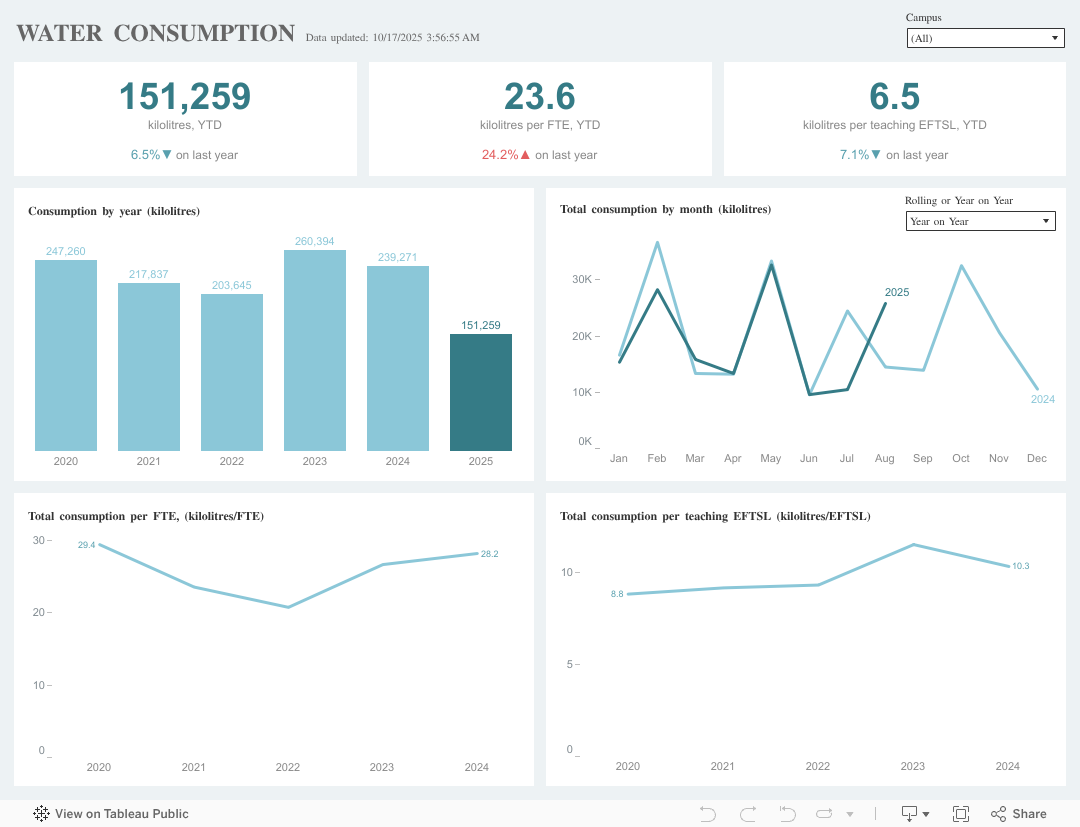
Water Consumption refers to the total volume of water used across all campuses, including Brisbane South (Nathan), Gold Coast, Brisbane South (Mt Gravatt)*, Logan and Brisbane City (South Bank).
Brisbane South (Nathan), Brisbane South (Mt Gravatt)*, and Brisbane City (South Bank) are billed monthly while Gold Coast and Logan are billed quarterly.
Water values are measured in kilolitres (kL).
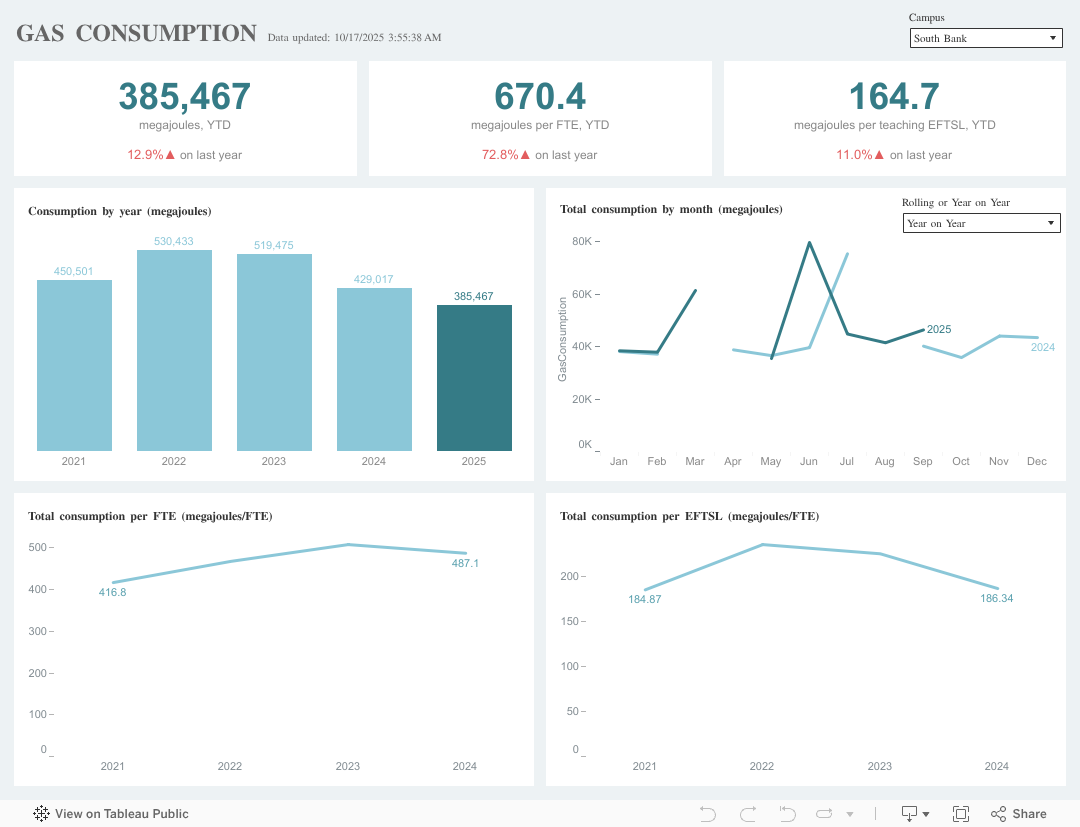
Gas consumption represents the total gas used across all campuses, including Brisbane South (Nathan), Gold Coast, Brisbane South (Mt Gravatt)*, Logan and Brisbane City (South Bank).
A value of '0' indicates no gas usage for that month, while negative values reflect gas returns due to site decommissioning. These returns are still included in the total consumption figures.
Gas usage is measured in megajoules (MJ).
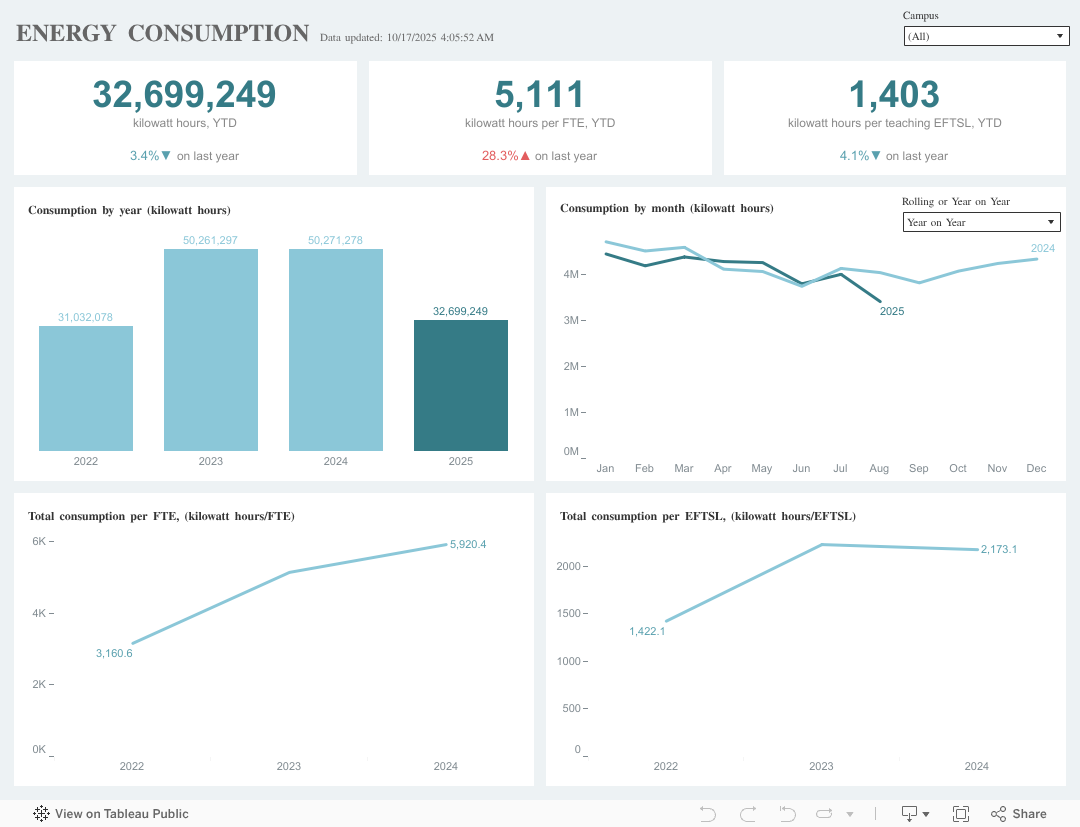
Energy Consumption refers to the energy consumed across all campuses, including Brisbane South (Nathan), Gold Coast, Brisbane South (Mt Gravatt)*, Logan and Brisbane City (South Bank).
Energy Consumption is measured in kilowatt-hours (kWh).
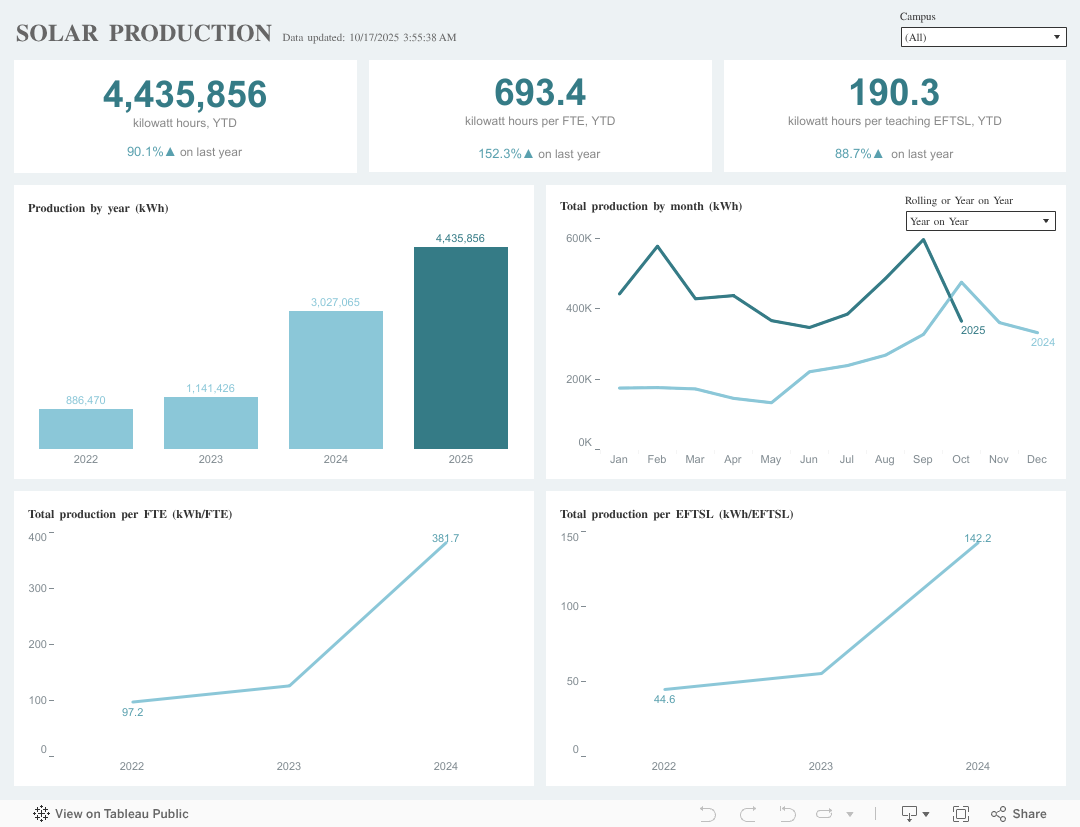
Solar Production refers to the total daily solar energy generated across all campuses, including Brisbane South (Nathan), Gold Coast, Brisbane South (Mt Gravatt)*, Logan and Brisbane City (South Bank).
Please note that the Brisbane South (Mt Gravatt)* is excluded from solar production calculations (e.g., production per FTE or EFTSL), as this location does not generate solar energy.
Solar production is measured in kilowatt-hours (kWh).
Full-Time Equivalent Employees (FTE) represents the total number of full-time staff, including casual employees. These totals are based solely on staff located at physical campus sites.
Teaching Effective Full-Time Study Load (EFTSL) totals reflect teaching activity at physical campus locations only. Please note that EFTSL values are not available until mid-year.
Population (Full-Time Equivalent Employees + Program Host EFTSL) refers to the sum of FTE and program host EFTSL including the physical campuses only.
*Please note that from 2026 Mt Gravatt Campus is closed, however historical data may include Mt Gravatt where noted.
Contact Griffith Sustainability
Griffith Sustainability Room 2.40, Building N54, Griffith University, 170 Kessels Road, Nathan QLD, 4111