Holistic perspectives on deep pasts, current global challenges, and unfolding futures
ARCHE aims to reshape how humanity understands its relationships with the Earth and prepares for emerging futures. By examining human-environment interactions across deep time, ARCHE reveals how societies have responded to environmental change, how those responses have influenced Earth systems, and what this means for navigating accelerating global challenges.
Bringing together internationally leading scholars and partners, ARCHE integrates archaeological, environmental, biological, and social evidence to trace long-term patterns in human behaviour, culture, and technology. Based in Brisbane and globally connected, ARCHE works in close partnership with Indigenous communities, grounding its research in place-based knowledge while addressing challenges of worldwide significance.
A Message from the Director
‘Who are we? Where did we come from? How have we shaped life on earth? How has it shaped us? These are just some of the questions that members of ARCHE are working to answer.
Our Centre undertakes active fieldwork and collaborative research projects in Australia and internationally, applying state-of-the-art scientific approaches to deepen our knowledge of human history and evolution.
As we investigate past human lifestyles and their effects on biodiversity and the environment, we glean critical insights that enhance our understanding of our place in the modern world and its variable ecosystems.
We provide an inclusive, creative and inspiring environment for both staff and students, and we encourage anyone who would like to join our Centre to get in touch.’
Professor Julien Louys
Director, Australian Research Centre for Human Evolution
International Initiative for Transforming Human Origins Research
Find out about the 'International Initiative for Transforming Human Origins Research' and our aim to address the human story in an entirely new and different way.
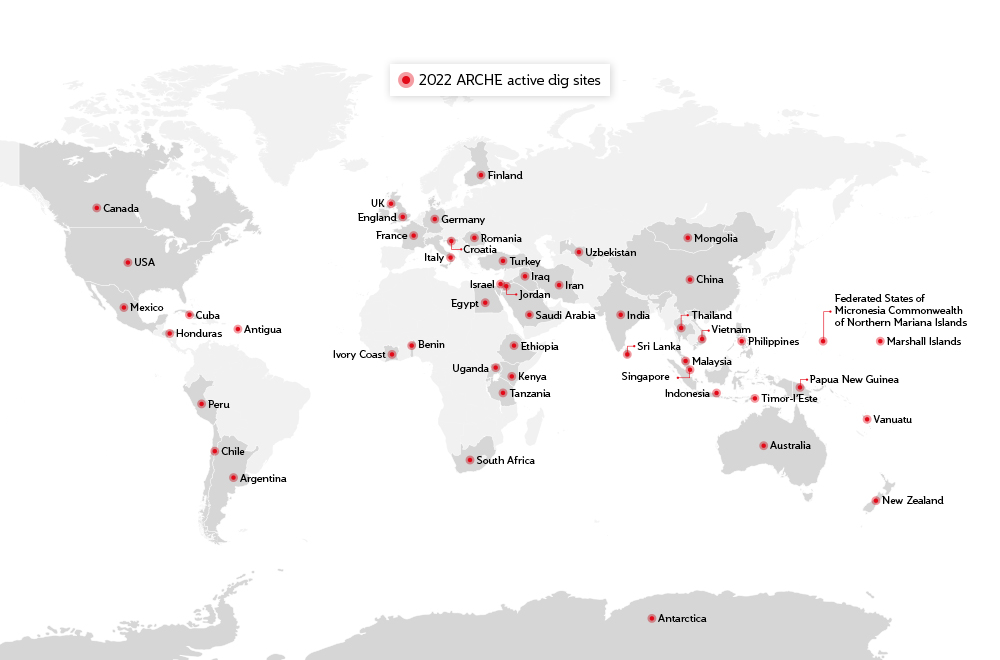
ARCHE operates across every continent on earth
From Asia to Antarctica with active archaeological sites in more than 45 countries. This international approach provides us with an expansive yet nuanced perspective on the story of human evolution, allowing us to capture both its broad strokes and watershed moments.
It also offers us the opportunity to compare and contrast how drastically different communities of humans have converged and deviated over time, deepening our understanding of human evolution on a local and global stage.
Raymond Dart Lecture Series
This annual event pays homage to one of Australia’s most celebrated palaeoanthropologists by presenting some of the brightest minds and newest research in the field.
Our Banner
The ivory female figurine of Hohle Fels depicted in our banner is the oldest image of a human being. It was unearthed in a cave in Germany in 2008 and is housed in the Prehistoric Museum of Blaubeuren (Urgeschichtliches Museum Blaubeuren). Sculpted from the tusk of a woolly mammoth, it was found in six fragments, with several pieces still missing. Its discovery pushed back the date of the oldest known human figurative art by several millennia, though interpretations of its meaning and symbolism are mixed.
With a loop in place of a head, this artefact may have been designed—or repaired—as a two-part piece, with the head being constructed from something organic. The loop indicates it could also have been worn as an amulet. Yuwaalaraay, Kamilaroi, Ngemba, and Wailwan artist Melissa Stannard explored this possibility, using traditional First Peoples weaving and ornamentation techniques. Stannard, Melissa K., and Michelle C. Langley. "The 40,000-Year-Old Female Figurine of Hohle Fels: Previous Assumptions and New Perspectives." Cambridge Archaeological Journal 31.1 (2021): 21-33.
Ice Age origins of one of humanity’s oldest drug habits
10 Sep 2026
Researchers discover betel nut – one of the world’s most widely used psychoactive substances...
Building the future of human origins: a new model for research
28 Aug 2026
Renowned archaeologists from around the globe gather to reinvigorate human origins research.
Bone ‘fingerprints’ unlock hidden stories of underwater caves
16 Jul 2026
New method to improve analysis of extinct megafauna and animal fossils found in underwater caves.
Archaeologist behind First Australians occupation record joins Griffith backed...
12 Feb 2026
Professor Chris Clarkson to lead research into Australia’s early history, strengthen Indigenous...
Australia’s First Peoples’ history
ARCHE's members are actively involved in research of Australia’s First Peoples’ history working in close partnership with Indigenous communities. Members take a broad approach to the study of First Peoples’ outstanding and diverse history with projects across Australia, focused on archaeology, rock art and genetics. ARCHE's scientific research aims to provide an appreciation of Australia's Indigenous past and to promote this for the benefit of the general public.
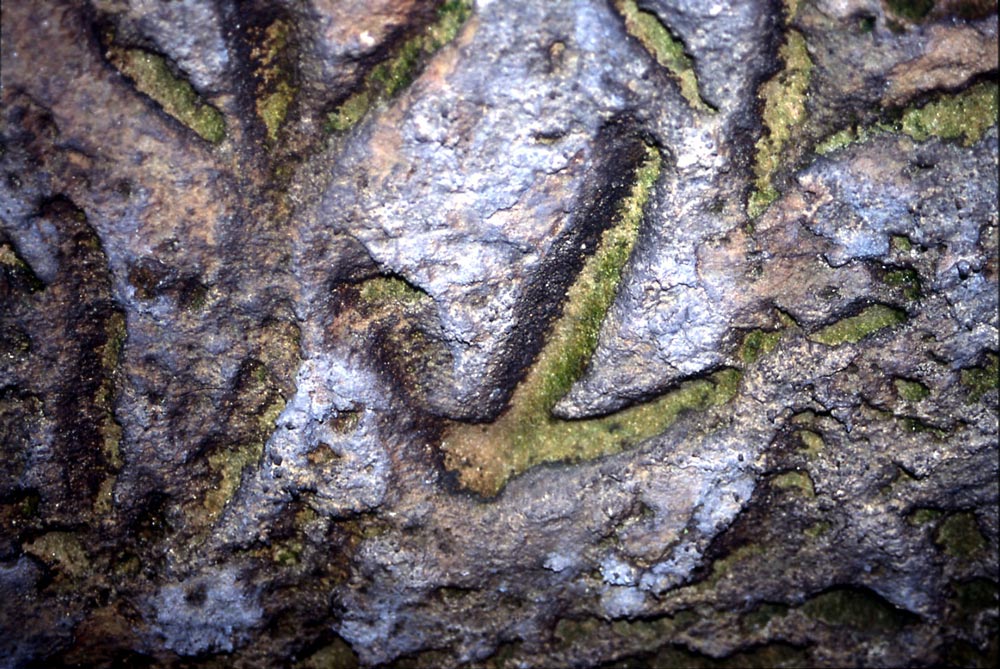
Emu track engraving from the Emu Cave site, Blue Mountains, NSW, that dates back at least 2,000 years. Courtesy of the Blue Mountains Aboriginal community. Photograph by Distinguished Professor Paul S.C. Taçon.
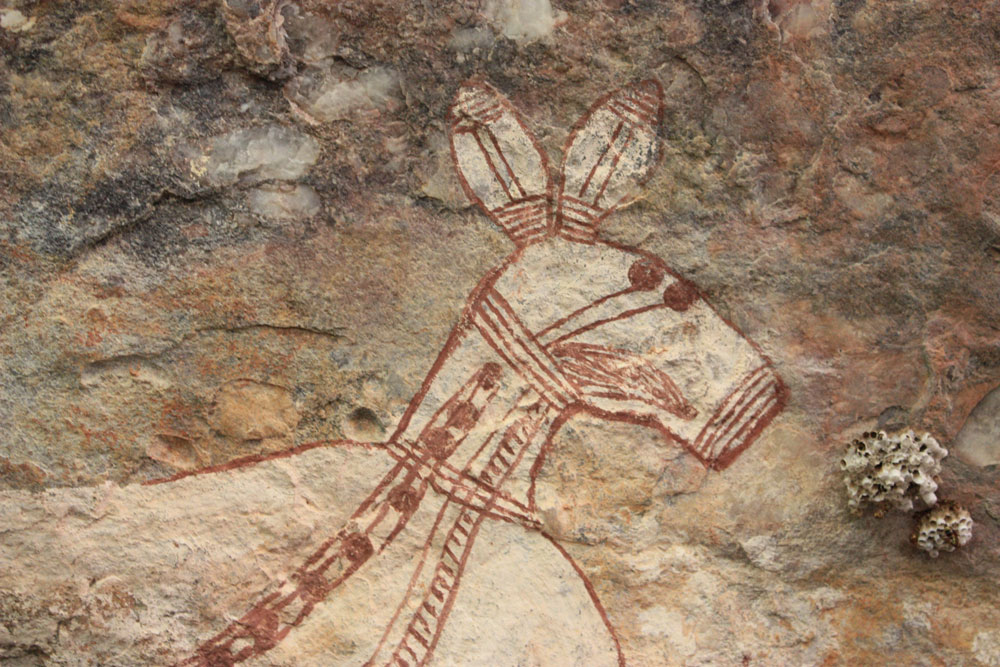
Macropod, Malarrak, Wellington Range, Northern Territory. Courtesy the Mawng Namunidjbuk community (Arnhem Land). Photograph by Distinguished Professor Paul S.C. Taçon.
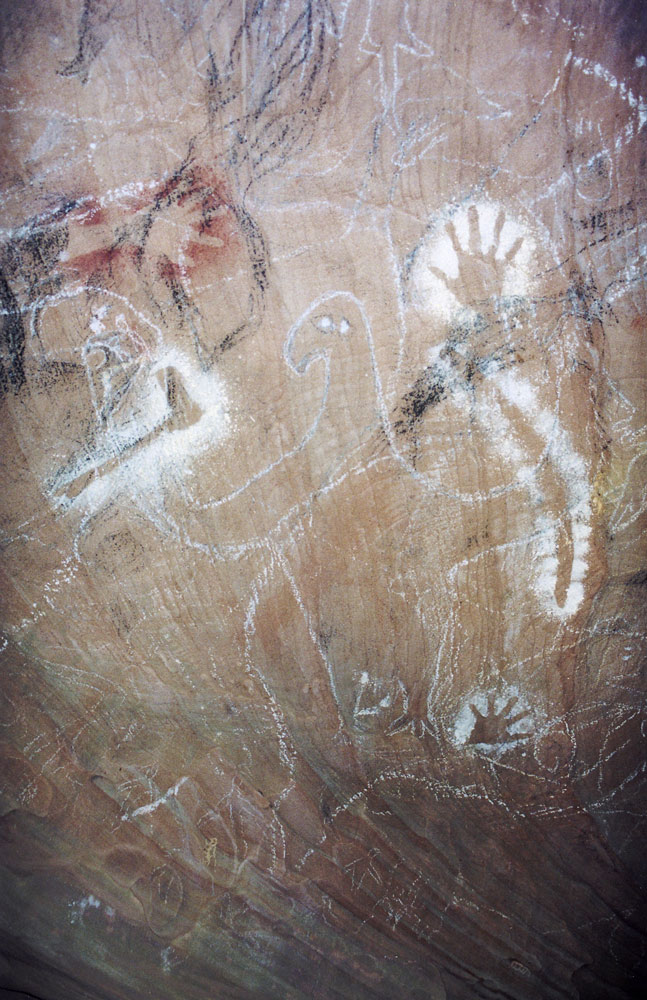
Rock art motifs at Eagle’s Reach, Wollemi National Park, New South Wales, Australia. Courtesy of the Darkinjung and Wiradjuri Aboriginal communities. Photograph by Distinguished Professor Paul S.C. Taçon.
Acknowledgement of Country
Griffith University acknowledges the people who are the traditional custodians of the land and pays respect to the Elders, past and present, and extends that respect to other Aboriginal and Torres Strait Islander peoples.
Family groups
Our Brisbane campuses are situated on the land of the Yugarabul, Yuggera, Jagera and Turrbal peoples. Logan is situated on the land of the Yuggera, Turrbal, Yugarabul, Jagera and Yugambeh peoples. The Gold Coast is situated on the land of the Kombumerri peoples, part of the Yugambeh language region.