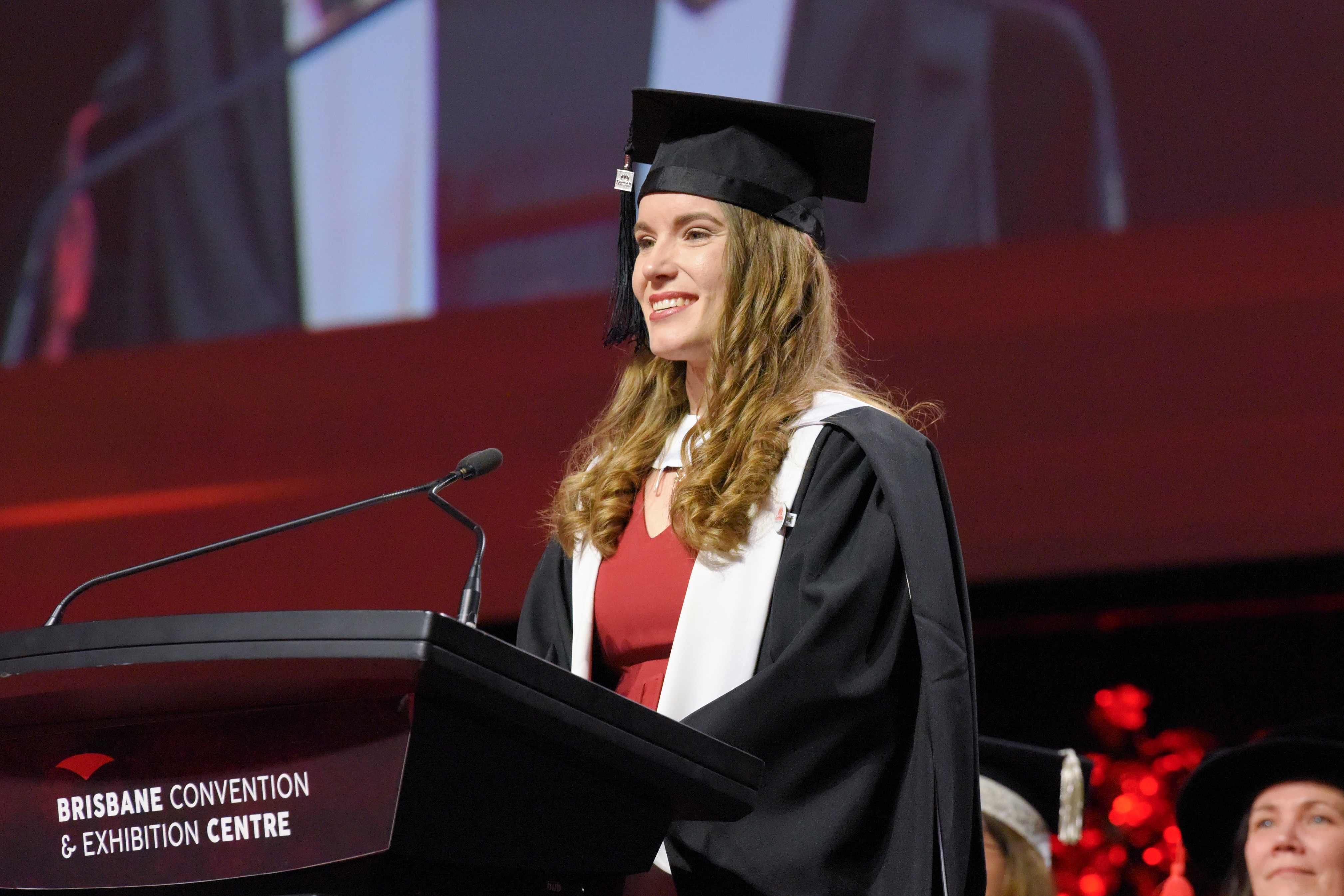
Communications and marketing specialist, Naomi Saines completed her MBA studies in 2025. We, the MBA Team, sat down with Naomi to talk about her motivations for pursuing an MBA, Artificial Intelligence Marketing and everything in between.
You keep yourself very busy as the Head of Marketing at Purpose Bureau, President of the Brisbane Junior Chamber of Commerce, and Founder of Kroll Consulting. How do you approach managing your time and balancing these roles?
I do have a lot going on, but they’re all roles I genuinely enjoy. For me, it comes down to what I find important.
My full-time role at Purpose Bureau gives me the opportunity to contribute in the climate tech space, working alongside really smart, agile thinkers. There’s a huge amount happening right now with the Australian Sustainability Reporting Standards and I find that space both exciting and meaningful.
As President of the Brisbane Junior Chamber of Commerce, that’s a volunteer role I tend to do on weekends and after work. I really enjoy being part of a community like that and contributing in a different way.
Then running my own business, Kroll Consulting, I get to work directly with ESG leaders across marketing, content and LinkedIn. That balance of structure and autonomy is something I value a lot.
From a practical perspective, I’m very intentional about how I plan my time. I break things down into small, manageable tasks and use project management tools to map out not just what needs to be done, but how long it will take (brains are great at making things seem bigger than they are). I check in on my priorities each morning and again in the evening so I’m clear on what the next day looks like.
I also try to be deliberate about rest. I’ve started protecting one full day, usually Saturday, as time that’s just for me. No life admin, no laundry, no work, just space to reset. Then I’ll often use part of Sunday for some deeper, focused work to set myself up for the week ahead.
You maintain a strong professional presence on LinkedIn. How can professionals from all backgrounds leverage platforms like LinkedIn to build their networks and elevate their work?
I think LinkedIn gets overcomplicated. Most people assume they need to have something big or impressive to say before they post and that’s usually what holds them back.
The people who build strong networks on LinkedIn are the ones who show up consistently and share what they’re already seeing in their day to day work. That could be a reflection on a project, something they’re noticing in their industry, or even a question they’re working through. It doesn’t need to be perfect, it just needs to be real.
The other piece is engagement. A lot of the value on LinkedIn doesn’t come from posting, it comes from how you interact with others. Thoughtful comments, starting conversations, supporting other people’s work. That’s where relationships actually build.
I also encourage people to be clear on what they want to be known for. You don’t need to talk about everything. Pick a few areas that matter to you and stay close to those. Over time, that consistency builds credibility.
And finally, treat it like a long game. You don’t see the impact immediately, but over time it compounds. Opportunities, connections, conversations, they come from showing up regularly, not from one post going viral.
For most people, it’s not about becoming a viral content creator. It’s about becoming visible for the work they’re already doing.
You’re passionate about sustainability, social impact and responsible business. Why do these areas matter so much to you, and how do you bring these values into your day-to-day work?
I was lucky to grow up in an environment where giving back and helping others was just normal. I also grew up in Western Sydney, in a really multicultural community. From a young age, I was surrounded by different cultures, perspectives, and lived experiences. That builds a natural sense of empathy and respect and you start to understand that the world needs to work for everyone, not just a few.
On the sustainability side, I’ve always felt a strong connection to nature. My family spent a lot of time outdoors and I was encouraged to slow down and appreciate it, whether that was something simple like noticing the shape of leaves or watching a sunset. That stays with you. It creates a sense of responsibility to protect it.
So for me, these values aren’t separate, they’re connected. It’s about people, planet, and the systems we build around them.
In my day to day work, that shows up in the kinds of organisations I work with and the way I think about business. I’m really interested in how businesses can create positive impact, not just through reducing harm, but through what they actively contribute. That could be through their operations, their supply chains, or the products and services they bring into the world.
Frameworks like the UN Sustainable Development Goals have also been influential for me. They highlight how interconnected everything is, climate, human rights, economic opportunity, and reinforce that responsibility sits across individuals, organisations, and governments.
At a simple level, if I’m going to spend a large chunk of my day hours working, I want that work to contribute to something that matters.
From a marketing perspective, how do you view the rise of artificial intelligence? In what ways do you use AI tools while staying mindful of the broader environmental and social implications?
AI is going to fundamentally change how we work and in marketing we’re already seeing that happen. I feel quite fortunate to have learned the foundations of my work before these tools existed, things like copywriting, consumer behaviour, and storytelling. That means I see AI as something that simply enhances those skills.
In practice, I use it as one of many tools in my toolkit. A good example is voice to text in AI, I’ll often talk through ideas so they come out naturally, in my own words, and then use AI to organise, refine, or tighten it. That way the thinking and tone is still mine and AI just helps shape it.
I think that’s the balance. The value still sits in human judgement, context, and understanding your audience. AI can support that, but it shouldn’t replace it. There’s always some level of fear with new technology. We saw it with the internet, with email, with so many shifts in how we work. The people who do well are the ones who learn how to use the tools while continuing to build their core skills.
At the same time, I think it’s important to be mindful of the broader implications. There are environmental costs, like energy and water use, and also social considerations around how it’s being used. For me, that means being intentional. Not using it for everything but using it where it genuinely adds value.
It’s just another tool in the toolkit, but how we choose to use it is what matters.
What motivated you to undertake the Griffith MBA? What aspects of the degree stood out to you when deciding it was the right fit?
I actually first came across the Griffith MBA through the Brisbane Junior Chamber of Commerce. At the time, I was at a point in my career where I was thinking about what was next. I’d built a solid foundation and had close to a decade of experience, but I wanted to step further into leadership and wasn’t entirely sure what the next step looked like.
I had always associated an MBA with very senior leaders, so it felt like a big decision, but really an MBA is for any leadership conscious person. When I looked into Griffith, what really stood out was the focus on responsible leadership and sustainability. That aligned strongly with my values and the direction I wanted to take my career.
It also felt very future focused. ESG is becoming a core part of how businesses operate and make decisions, particularly at board and investor level, so having that embedded into the degree was really important to me.
The flexibility of the program was another key factor, especially while working. And something I didn’t expect, but really valued, was the community. Even during the research phase, I was able to connect with past students who were incredibly generous with their time. That continued throughout the program and it’s something that’s stayed with me. It’s a close-knit group and those relationships have carried well beyond the degree.
Finally, what advice would you offer current or future MBA students?
Speak to people who’ve done it. LinkedIn is a great place to start. Look at who in your network, or even second connections, has completed the MBA and reach out (go to Connections > Filters > Education > Griffith University). Most people are happy to share their experience, and it gives you a much more realistic view of what it’s like.
It’s a commitment, especially if you’re working at the same time, so it’s important to understand what it will take. But also ask people what they got out of it, how it shaped their thinking, their career, and their network, and how they made it work in their life.
If it aligns with where you want to go, it’s a really valuable investment.
If you have a question, we encourage you to connect with Naomi on LinkedIn.
You may also like
Jason McKenzie
Jason shares insights into his international career, how he started his own international business venture and his recent announcement of being awarded the prestigious “Knight in the Order of Academic Palms” award, originally instituted
by Napoleon in 1808.
Marvel Nartey
Marvel has been a nurse for 16 years. Find out what first inspired her to pursue a career in health, and what continues to drive her passion for caring for others.
Professor Nick Barter
Nick was MBA Director for several years and currently teaches into the MBA program. In this interview, Nick reflects on his leadership of the program, gives us a glimpse into the book he co-authored, and shares advice for future MBA students.