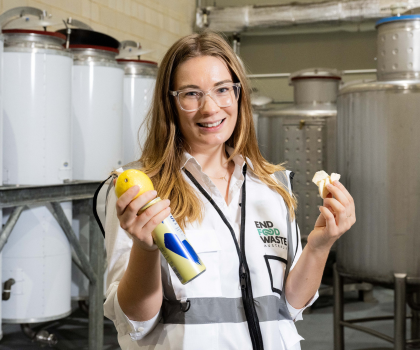
 Pictured: Francesca Goodman-Smith, End Food Waste Australia
From tackling food waste to driving sustainable business innovation, Francesca’s career demonstrates the power of combining science, research and business to create meaningful change. As Director of Research, Development and Extension at End Food Waste Australia, Francesca leads initiatives that bring together industry, government and researchers to address one of the world’s most pressing sustainability challenges.
A Griffith MBA graduate, Francesca shares how her studies have strengthened her leadership and strategic capabilities, the importance of collaboration in driving systemic change, and how students can make the most of the opportunities an MBA offers.
You've built a career at the intersection of science, sustainability and business. What first sparked your passion for tackling food waste, and where has that passion taken you?
My passion for food stems from childhood. My dad is an engineer but took a career break to follow his own passion for food and retrained as a chef. His courage to follow this was something that stuck with me and I carried into my own career. While I was at Otago University, I began volunteering with food rescue organisation KiwiHarvest and facilitated community cooking workshops focused on food security and helping people gain the confidence to cook.
A pivotal moment for me was during a course I took on food and society during my undergraduate degree led by Professor Miranda Mirosa. Food waste was a key focus of the course, and we took a field trip to the local landfill. This experience was mind-blowing, seeing the scale of waste that is produced and learning that one-third of food produced globally is wasted was truly shocking. I felt like tackling food waste was an area where real change could occur. From there I went on to study a Master of Science, quantifying retail food waste in New Zealand and then I worked as a Waste Minimisation Manager for New Zealand’s largest grocery retailer, Foodstuffs, helping over 150 sites divert more than 85% of waste from landfill—amounting to approximately 40,000 tonnes annually and supporting the redistribution of 15 million meals to people in need.
Currently, I serve as Director of Research, Development and Extension at End Food Waste Australia. My role involves leading a team dedicated to delivering a $32m R&D program, building strategic partnerships and translating research into actionable solutions across industry and government.
You recently attended the European Summer School for Advanced Management (ESSAM) at the University of Glasgow as part of your Griffith MBA. What were your biggest takeaways, and how has the experience influenced your thinking as a leader?
Finishing my Griffith University MBA with a trip to Glasgow University to complete the European Summer School for Advanced Management (ESSAM) was an incredible way to conclude the degree.
The cohort of students from global universities came from 17 different countries and diverse professions, making the learning opportunities from fellow students just as rich as the teaching itself.
The leadership content delivered through the program was presented in an engaging and practical way, with many opportunities to debate approaches and challenge leadership assumptions. One key takeaway was the notion of “an incomplete leader in a complete team”. This concept takes the onus off the leader to have all the answers and shifts toward a mindset of leading with questions to get the best out of teams.
The second week of the course at the regional Dumfries campus was where the rubber hit the road and we put our learnings into action with group consultancy projects for renewable energy provider Natural Power. Working on real-world issues with a future focused company was a highlight of the ESSAM Program. The group work brought its challenges, especially under tight time pressure. I saw my role in the group as a mediator, helping to bridge the gap between different opinions and come up with solutions to resolve conflict while maintaining focus on the key deliverables.
Your career has spanned government, industry, research and the not-for-profit sector. How have those experiences shaped your approach to tackling complex sustainability challenges?
No one actor can solve the challenge of food waste as solutions rely on government, industry, academia and the not-for-profit sector coming together to enable and implement actions that fundamentally shift our food system. Having worked within organisations at each of these stages I have an understanding of the pressures, drivers and levers for change and the value of bringing these stakeholders together. For example, a research project I was involved with saw a food rescue organisation and a state government research partner come together to work on a project to create shelf-stable meals from food surplus for disaster relief in consultation with First Nations communities. The collaboration between these groups enabled a culturally appropriate and fit-for purpose solution to be developed.
What motivated you to undertake the Griffith MBA and apply for a scholarship, and how has it influenced your leadership and career?
My background is in science and sustainability management. I recognised that to truly influence systems change at scale an MBA was a helpful tool to gain the business acumen needed to communicate and drive change in commercial environments. Griffith University’s MBA, with its strong focus on responsible leadership and sustainable business, was the perfect fit.
The MBA has given me the tools to better communicate sustainability benefits in commercial and strategic terms. The skills I’ve developed are directly applicable to my current role, where I work with industry, government and NGOs, who have different drivers and approaches to tackling food waste.
On a personal level, the MBA has also strengthened my confidence as a female leader and affirmed the importance of bringing diverse voices to the forefront of business discussions.
Much of your work involves bringing together industry, government and researchers. What have you learnt about leading collaboration and driving meaningful change across diverse stakeholders?
End Food Waste Australia’s research model is a Cooperative Research Centre. This is specifically designed to bring together industry, research and government in a collaborative way to contribute systemically to food waste reduction. Working within this organisational structure has been incredibly rewarding as change can be co-designed with industry to achieve outcomes which benefit the sector as a whole. My background working for government, then industry and staying attached to academia through my studies and research networks has been invaluable in helping me to understand the different drivers for change and benefits that resonate with different stakeholder groups.
From helping develop the world's first Upcycled Food Certification to contributing research recognised by the United Nations, you've already made a significant global impact. Which achievement are you most proud of, and why?
I'm most proud of my role in helping develop the world's first Upcycled Food Certification. By turning research and industry collaboration into a practical tool, this work supports innovative and purpose-driven food businesses to quantify and communicate the impact of their sustainability efforts through a verifiable and evidence-based process.
What makes it meaningful to me is the multiplier effect. Rather than solving food waste one product or one company at a time, the certification gives industry a shared standard and a market incentive to rescue ingredients that would otherwise go to waste which means the impact scales far beyond anything one business could achieve alone.
Being part of a Standards Committee with such talented and experienced professionals was an amazing learning opportunity for me at that early stage of my career. I have continued to collaborate with others on the committee and now have friends and contacts across the globe who I have remained connected with.
As you prepare to graduate, what's next for you? What impact do you hope to have on the future of sustainable business, and what advice would you give to others considering an MBA?
I aspire to accelerate systemic change at the intersection of business, research and government. I am enjoying the challenges and opportunities of my current role at End Food Waste Australia, where I am involved in shaping the future direction of the organisation. My MBA studies at Griffith University have helped to build the strategic, financial and leadership capabilities that are important in helping the organisation to navigate competing government priorities, constrained fiscal environments and evolving industry needs.
My biggest piece of advice to any MBA student is to look for the unique learning opportunities that take you out of the classroom. Taking part in ESSAM truly elevated the MBA experience and is something I will never forget. I would absolutely encourage other Griffith MBA students to take up this amazing opportunity to study abroad and connect with students across the globe.
You may also like
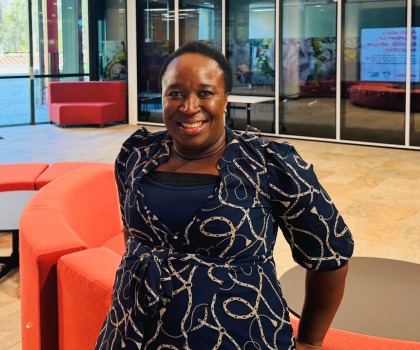
Marvel Nartey
Marvel has been a nurse for 16 years. Find out what first inspired her to pursue a career in health, and what continues to drive her passion for caring for others.
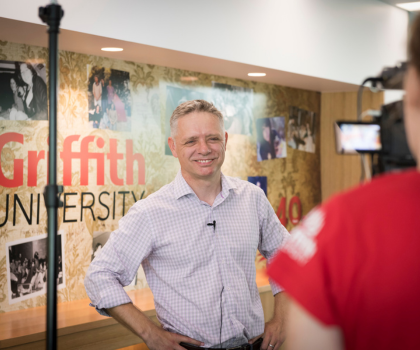
Professor Nick Barter
Nick was MBA Director for several years and currently teaches into the MBA program. In this interview, Nick reflects on his leadership of the program, gives us a glimpse into the book he co-authored, and shares advice for future MBA students.
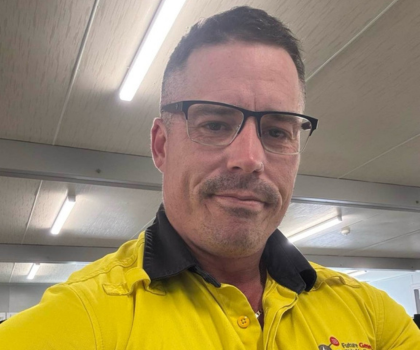
James Musicka
After working with major companies in Australia, like BHP and Webuild, later in his career, James' interest was sparked by seeing how other people and businesses operate and what makes a business.