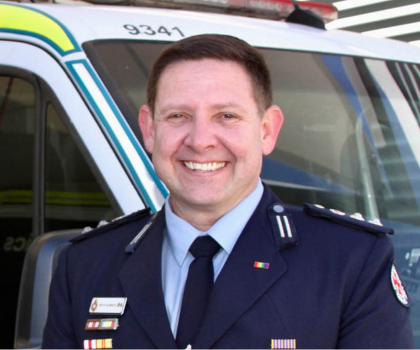
From making life-and-death decisions on the frontline as a paramedic to leading more than 600 staff as Assistant Commissioner of the Queensland Ambulance Service, Andrew has built a career defined by service, leadership and innovation. In this conversation, he reflects on the lessons that shaped his leadership journey, the future of healthcare and ambulance services, and why authenticity remains the key to driving meaningful change.
You began your career on the frontline as a paramedic - how has that experience shaped the way you lead at an executive level today?
As a paramedic you have to be able to make quick decisions based on available intelligence, in often high-pressure situations. You need to do this while collaborating with colleagues, communicating with families and bystanders all while planning your next 10 steps to keep the patient safe and get them to hospital. You have to build strong relationships with other health service professionals to make the patient journey seamless. All of this adds up to becoming good at making decisions in difficult circumstances, growing strong communication skills and getting very adept at stakeholder engagement.
I learnt a lot about myself in those early days about how important our role in community is and how respected our profession is. It grounds me in my decision making to this day when I am leading a region of 600+ people.
In your current role as Assistant Commissioner, what are your key priorities in delivering high-quality ambulance services across your region?
Staff welfare and safety, building community connection, patient safety, health equity and sustainability of our service delivery model are my key priorities at the moment.
These priorities align with our organisational strategic intent and that of Government. I am lucky to work in a service that highly values the need for staff-informed strategy. As a result we are in the process of developing our second QAS 5-Year Strategy which is informed and built by staff from the ground-up through an extra-ordinary amount of consultation with thousands of staff. It is a case study in strategy being well-designed with buy-in from staff “baked in” right from the get-go.
How do you approach building inclusive, high-performing teams in a large and diverse organisation like QAS?
I seem to be good at building teams now. It’s become one of my strengths but it wasn’t always this way. In fact I think I was pretty bad at it in the early days of my leadership journey.
I’ve learnt that the most important thing that a leader can do is to seek out and take on the feedback your given and incorporate it into adjusting your leadership style over time. The ability to take on feedback and not have an emotional reaction to it is a game-changer. All feedback, whether you agree with or not, is a fabulous “thought exercise” for you to reflect on what you could do better next time. And then grow from it..
If I was the same leader now as I was 12 years ago – I wouldn’t be in this job now. I wouldn’t have been ready for it.
You’ve been recognised for your leadership and impact, including as a Griffith Business School Outstanding Alumnus - what does that recognition mean to you?
It was and remains a truly humbling experience and honour. I was so chuffed to even be nominated. The award was another link in my journey through Griffith University Business School. The networks and connections that I have built over the years with staff and fellow students continues to endure and is one of the great legacy pieces that comes out of the MBA program. The award was another reminder to me that I’m good at what I do and to back myself more (as my husband is always telling me to do).
Healthcare is undergoing rapid change - what do you see as the biggest challenges and opportunities for ambulance services right now?
Our biggest challenges are in the sustainability of health services provision in a world where we are living longer and with more long-term and complex illnesses. We really are the lucky country in Australia where we have such amazing and world-class health services provided free to every citizen.
This creates complexity though in times of upheaval when global events (e.g. Iran / US War) clash with more local challenges (interest rates / inflation) which puts pressure on already strained systems. The challenge we have is how to work differently and smarter with our existing funding envelope to make health services sustainable into the future. The answers lie in strategy, innovation and listening to staff and the community, all of which are key pillars of our 5-Year strategy.
How are innovation and technologies like AI and improved connectivity transforming care delivery, particularly in regional and remote communities?
Innovation in healthcare and ambulance services is bringing incredible advancements in clinical practice to rural and remote communities.
Imagine being in a car accident in the middle of central Queensland with the attending paramedics being able to consult over satellite wifi with an QAS Emergency Physician in Brisbane for life-saving interventions. These are things we are already doing now in 2026.
The power of AI and machine learning are gradually and safely being tested and incorporated into ambulance dispatch software which is leading to greater predictive resource deployment. We are getting to a place where we can more accurately predict where the next job will come in and how we can minimise response times for patients in community. It’s a very exciting time to be working in this space.
What advice would you give to future leaders - particularly in healthcare - who want to lead with authenticity and drive meaningful change?
Authenticity – or being your whole self in your job is the whole game.
I think when you take on a leadership role, you have to give your all too it – which means letting your people know you, understand you and relate to you. There is a level of vulnerability that comes with being a truly authentic leader – but I really think it is the “superpower” that allows your team to buy into your vision and also see that you really care about what you are doing.
When you are driving change, there is nothing more powerful than people knowing your “why”.
You may also like
Melissa Mullen
Melissa Mullen is a Senior Advisor of Safety Systems and Training at Australia’s largest rail freight operator, Aurizon. We, the MBA Team sat down with Melissa to gain an insight into her dynamic role and how she has harnessed the skills she has acquired through her MBA studies.
Jessica Fox
Olympic gold medallist Jessica Fox OAM is used to performing at the highest level - and she’s bringing that same mindset to her studies as a Griffith MBA student.
Francesca Goodman-Smith
Francesca is a sustainability leader working at the intersection of science, business and food waste reduction. In this interview, Francesca reflects on her journey from food waste research to leading a national research and development program, how the Griffith MBA has strengthened her leadership and strategic capabilities, and her advice for students looking to make a meaningful impact through their careers.