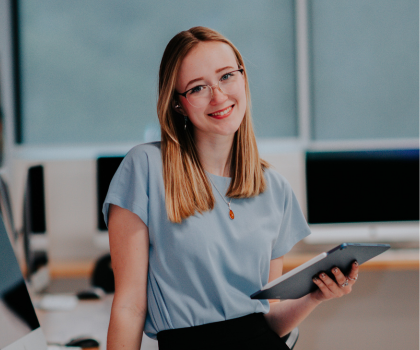
Pictured: MBA Student, Amber Wilson
Amber’s path reflects a shift not in direction, but in perspective — moving from creative execution into the strategic thinking that shapes it. With a foundation in design, her decision to pursue an MBA is driven by a desire to understand the bigger picture, expand her influence, and stay ahead in an industry being reshaped by AI.
In this conversation, Amber explores the intersection of creativity and business, the value of human‑centred thinking in leadership, and how purpose and curiosity continue to guide her next steps.
Your academic background is creative and communication-focused. What drew you to take the next step into an MBA at this point in your life?
I have always been interested in the strategy behind design and art – analysing how something is perceived by the audience, what is communicated and why it works. It is this integration of communication and aesthetics that got me into design. But after a while of working in the industry, I started to feel a bit trapped. I could see how my work contributed to the bigger picture, but I wasn’t a part of the bigger picture. I wanted more context and more influence in the decisions, not just executing the brief I was given.
Simultaneously, AI quickly began to grow and take over the creative and marketing industry. It started changing what skills were valuable to businesses and how works get done. I didn’t want to keep chasing the trend, I wanted to understand what was driving the change so I could make better decisions with it.
Then I read Will Murillo’s blog post on Medium ‘The journey of a designer through an MBA’ which helped me come to the realisation that the next step for me was to broaden my perspective and build the skills to lead.
The MBA feels like the right move. It builds on how I already think while also pushing me to step into roles where I can shape the direction that I would previously just be responding to.
What stood out to you about Griffith’s MBA when you were exploring different postgraduate options?
When researching MBA programs in Australia, there were a few things that stood out to me that ultimately led me to choosing the program. First was convenience. I was in the process of moving to Brisbane at the time, so flexibility was a big factor. The ability to study in-person, online or hybrid made the Masters feel achievable without having to sacrificed work-life balance.
The second was how naturally Griffith's focus on sustainability fit with my values and where I want to take my career. I want this MBA to lead me to opportunities where I can help people, so a program that considers impact alongside business outcomes, not just profit, felt like the right choice.
The third was customisability. Coming from a design background, I felt a bit like a fish out of water in a business program, so the range of electives and pathways was reassuring. It meant I could shape the course to a more creative industry context rather than stepping completely out of my comfort zone.
Ultimately, Griffith wasn't just a practical choice, it was the right one! A program that could be flexible around my life, reflect my values, and match my career as a creative was exactly what I was looking for.
You were awarded the MBA Sustainable Leadership Scholarship for Women. What did receiving that scholarship mean to you, and what do you think it recognised in you?
Receiving the MBA Sustainable Leadership Scholarship for Women meant more to me than I expected it would. It felt like a vote of confidence in where I’m at and where I can go. I've finished a degree, completed multiple courses, built a career, and run my own freelance practice - all while trying to make my work mean something. I'd like to think the scholarship reflects not just what I've done, but how I've done it. With curiosity, purpose, and a pretty clear sense of what I care about. I have always tried to let my values guide my work– sustainability, feminism, environmental impact, etc. I think that’s what the scholarship recognised. The drive and intention behind my work not just the output.
When I announced I was doing an MBA, a lot of people questioned it – I'm a designer, not a business person. Receiving this felt like confirmation that crossing into business as a designer is a path worth taking.
This scholarship comes with responsibility. It's made me more conscious of how I show up and what I actually do with this opportunity. I want to contribute in a way that reflects why I was chosen, and hopefully, in a way that makes it a little easier for the next creative or young woman who takes a path that doesn't look obvious on paper.
Coming from a design background, how have you found engaging with subjects like marketing, strategy and leadership so far?
I started the MBA expecting to feel out of my depth, but it hasn’t been like that at all. Instead, I have realised how connected the content is to the work I have already been doing. Design teaches you to understand people, context and constraints before jumping to solutions. This way of thinking translates directly into the MBA – the context is just zoomed out. Instead of focusing on design executions, I am now understanding the systems around it.
Going in, I was nervous about the spectrum of subjects – marketing felt familiar, while finance felt completely removed from my world. Despite my preconceptions, I was pleasantly surprised! The finance subjects revealed how organisations actually operate, changing how I reflect on my career and the decisions that were being made around me in previous roles. While marketing was familiar territory, the course still managed to pull back the curtain on its structure and how decisions are shaped long before anything reaches a designer’s desk.
One trimester in and I'm feeling engaged and excited. My perspective has changed more than I expected. I'm less focused on the work itself and more curious about why it exists, how it's positioned, and what it's trying to achieve. I'm looking forward to seeing where that curiosity takes me!
With AI already reshaping creative industries, how do you see its impact on design, and how has the MBA helped you think more broadly about that shift?
AI is commodifying design execution, making a lot of what we do faster and cheaper. Skills that used to be valuable are becoming accessible to anyone, which is concentrating the market. For many it’s a scary thought, unless you’re willing to pivot.
I don’t see this as a threat unless I stay fixed at the execution-based level. It’s just pushing me to move up the chain into thinking, direction, and decision making.
When people ask if I am worried, my answer is always the same. AI is a pattern machine; it recombines what already exists. It can produce volume and variation, but it doesn’t have lived experiences, cultural insights or human creativity. The best creative work has always come from people who see things differently, and that kind of perspective isn’t something you can train a model on if it hasn’t existed yet.
Griffith’s MBA program has helped me see this industry change more clearly. It’s already becoming less about tools and more about where you sit in the process. The MBA is essentially preparation for this change – I’m developing skills around strategy, and leadership that AI can’t replicate.
You’ve been influenced by strong women in your life, particularly your mum and grandmother. How have they shaped your perspective on education, independence and purpose?
I grew up in a small and close-knit family. Each person has shaped my career, values and perspective in different ways. My poppy sparked my creativity and communication skills at a young age, and my dad has always motivated me to push myself to be the best I can be. But as I've grown and matured, I've developed a deeper respect for the women in my family for their achievements, resilience and the way they continue to influence me.
My nanna always told me the story of how her own mother was denied an education because it was “for the boys.” Because of this inequality, nanna made a conscious effort to educate herself, and then passed that value down to my mum, and in turn, to my sister and myself.
My mum has also strongly shaped how I think about my career. During an undergrad project, I interviewed her about her career evolution. She spoke of a crossroads after working in corporate, where she realised she wanted her work to align with her values. Upon pondering that sentiment, I realised the same. Since then I worked for Fire and Rescue NSW to educate communities on fire safety, took on freelance work addressing gender-based violence and am continuing to seek out value-driven work.
My sister has also recently started playing a role in shaping my perspective. Watching her pursue a career in medicine and seeing the challenges she’s faced as a woman in that industry has reinforced my belief that gender inequality is still very real in our society. It’s inspiring watching her, alongside many other women in my life, expose the unconscious misogyny still present in our society.
Together, their influence has shaped how I view and approach my education, career and everyday actions.
When you think about the future, what kind of impact would you like to use your skills and education to make?
When I think about the future, the kind of impact I want to make is shaped a lot by how I’ve seen work approached in my own life. Like my mum, I’m drawn to good, value-driven work. Whether that’s through the organisations I’m part of, the problems I help solve, or the people I work with every day. It’s less about a specific role and more about the effect of the work itself.
A big part of that is also showing that creative professionals have a place in strategic and leadership conversations. There’s often a gap between those shaping direction and those thinking deeply about people, experience, and context. Research from Creative Australia highlights that creatives are often highly skilled and educated yet undervalued in terms of income and influence. At the same time, with the rise of AI, I think the arts and humanities are increasingly being overlooked or misunderstood, even though the human-centred thinking they bring is becoming more important, not less. I want to challenge that perception.
The MBA is giving me the ability to step into these spaces with confidence to make a change. Design has trained me to advocate for the end user, to question who something serves, who it might exclude, and whether it can be improved. I want to carry that instinct into every room I’m in.
The specific causes I care about will evolve over time, but the main thread won’t. I want to use whatever skills and influence I build to make things a little more just, a little more honest, and a little more human.
To learn more about Amber or to connect please visit LinkedIn.
You may also like
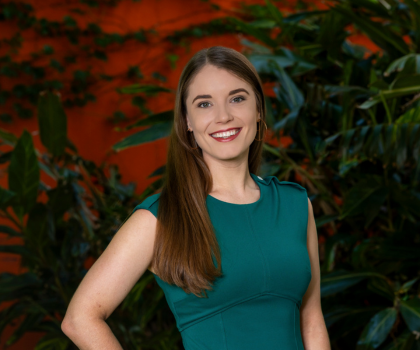
Naomi Saines
Naomi is a communications and marketing specialist who is striving to make a positive impact within the realms of sustainability and social impact. In this interview, Naomi talks about how she manages her busy schedule, Artificial Intelligence (AI) Marketing and her advice for future MBA students.

Andrew Hebbron
Andrew is the Assistant Commissioner of the Queensland Ambulance Service, a former frontline paramedic and Griffith MBA alumnus whose leadership focuses on staff wellbeing, innovation, community connection and building high-performing teams to deliver sustainable healthcare services.
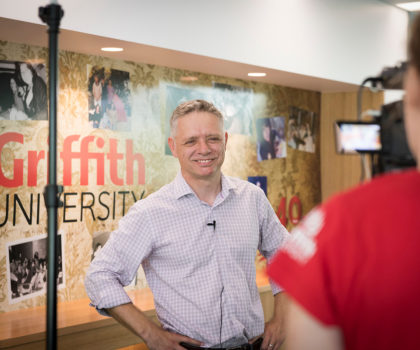
Professor Nick Barter
Nick was MBA Director for several years and currently teaches into the MBA program. In this interview, Nick reflects on his leadership of the program, gives us a glimpse into the book he co-authored, and shares advice for future MBA students.