Co-developing innovative responses to reduce heat risk within urban systems
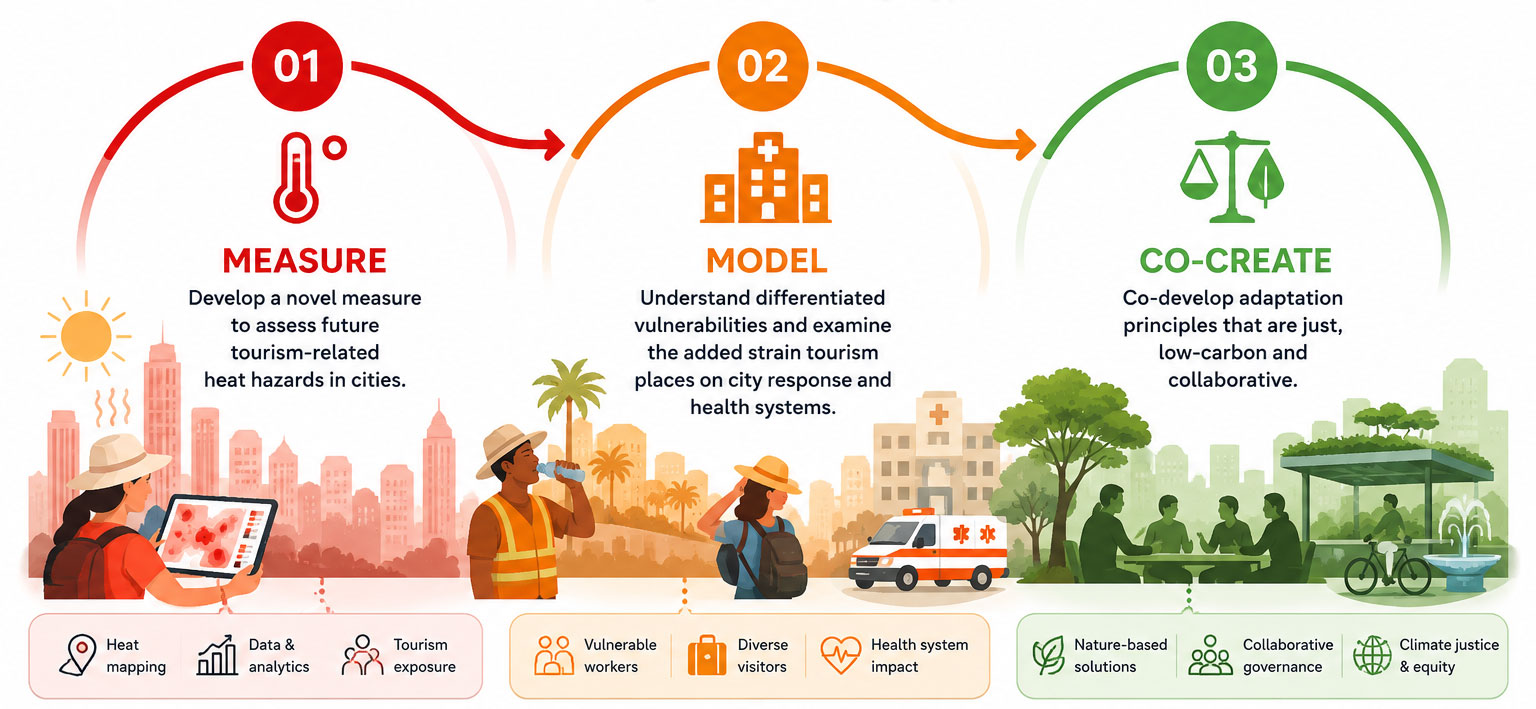
Extreme heat is becoming one of the greatest climate risks facing cities, threatening public health, tourism, infrastructure and economic productivity. This project tackles the critical need for heat adaptation in cities. As intensifying heatwaves increasingly threaten lives and economic productivity, this study develops a novel measure to assess future tourism-related heat hazards, examines the added strain on city response systems by tourism, and establishes new insights into differentiated vulnerabilities amongst tourists and workers. This project explicitly recognises tourism workers, a group often neglected in climate adaptation research. It places climate justice at the forefront, examining the diverse ways in which tourism workers and different types of visitors may be disproportionately affected by extreme heat.
By integrating a global analysis with three city case studies, this research co-develops innovative responses to reduce heat risk within urban systems. A new set of adaptation principles will help prioritise low-carbon, just responses, implemented through collaborative governance systems across different scales and sectors.
Australian Research Council Discovery DP260101699


Sustainable Development Goals
Griffith University is aligned with the United Nation's Sustainable Development Goals (SDGs) and committed to creating decent work and economic growth, sustainable cities and communities, and tackling global challenges around climate action and life on land.
Why this research matters
Every year cities become hotter. Extreme heat threatens:
- visitors
- tourism workers
- city infrastructure
- visitor economies
- public health
Our ARC Discovery Project develops practical, low-carbon solutions that help cities become safer, more resilient tourism destinations.
What makes this research different?
This project takes a unique approach to understanding and responding to extreme heat in urban tourism by:
- Developing the first tourism-specific heat hazard measure
- Prioritising the experiences of tourism workers
- Applying a climate justice lens
- Identifying low-carbon adaptation pathways.
Our key focus areas
Case studies
Brisbane
- 50M+ visitor nights
- Host of 2032 Olympic Games
- Named among Travel + Leisure's 50 Best Places to Travel 2026 — and ranked the world’s 9th most relaxing city to live in.
Gold Coast
- 14.4M visitors in 2025
- 10M+international nights
- Australia's #1 domestic holiday destination— with a visitor economy built around outdoor, peak-heat activity.
Sydney
- 122M visitor nights
- Major international gateway
- Already active on heat: the Sydney Heat Smart City Plan is being led by the Greater Sydney Heat Taskforce.
Meet our researchers
Professor Susanne Becken
Professor of Sustainable Tourism, Griffith Institute for Tourism
Dr Raymond Rastegar
Justice, sustainability transitions, and environmental conservation.
Associate Professor Johanna Nalau
Climate adaptation
Professor Jamie Ranse
Public health, emergency and in-event health services for mass gatherings.
Professor Daniel Scott
Climate change and tourism/recreation, sustainable tourism, climate change impacts and adaptation.
Dr Patrick Amoatey
Climate change, heat risk and health.
Previous outputs leading up to the project
Project information sheet
- Extreme Heat in Cities: Co-developing just adaptation for urban tourism (Download PDF 800 KB)
Conference presentation:
- Becken, S; Scott, D; Rastegar, R; Nalau, J, “Sunlust” or heatwave? Impacts of future heat exposure in city destinations, CAUTHE 2025 Conference, 2025. https://hdl.handle.net/10072/436242