Exploring the intersection of climate justice and tourism to embed justice into climate policies and drive more sustainable, inclusive tourism development
This project is driven by the pressing need to embed justice within climate policy and actions to ensure that climate change impacts and initiatives do not perpetuate historical and ongoing social and environmental vulnerabilities. While discussions around sustainability and justice in the context of climate change have been significant, there remains a gap in efforts to integrate these two aspects for a truly just sustainability transition. This project aims to explore the complex relationship between climate change, climate justice, and tourism, focusing on the interconnected challenges that arise in tourism-related sustainable development.
By analysing notions of justice and the narratives that underpin them, the project seeks to systematically identify and address context-specific justice challenges within climate policies and practices relevant to tourism. This approach is particularly important because economic factors often dominate policymaking, potentially overlooking local contexts and sidelining essential social, cultural, and political considerations. Through targeted empirical research, the project will substantiate these justice challenges, providing practical insights for effectively integrating justice considerations into the climate discourse and actions relevant to tourism.



Sustainable Development Goals
Griffith University is aligned to the United Nation's Sustainable Development Goals (SDGs) and committed to tackling global challenges around peace, justice and strong institutions and partnerships for goals.
Key focus areas
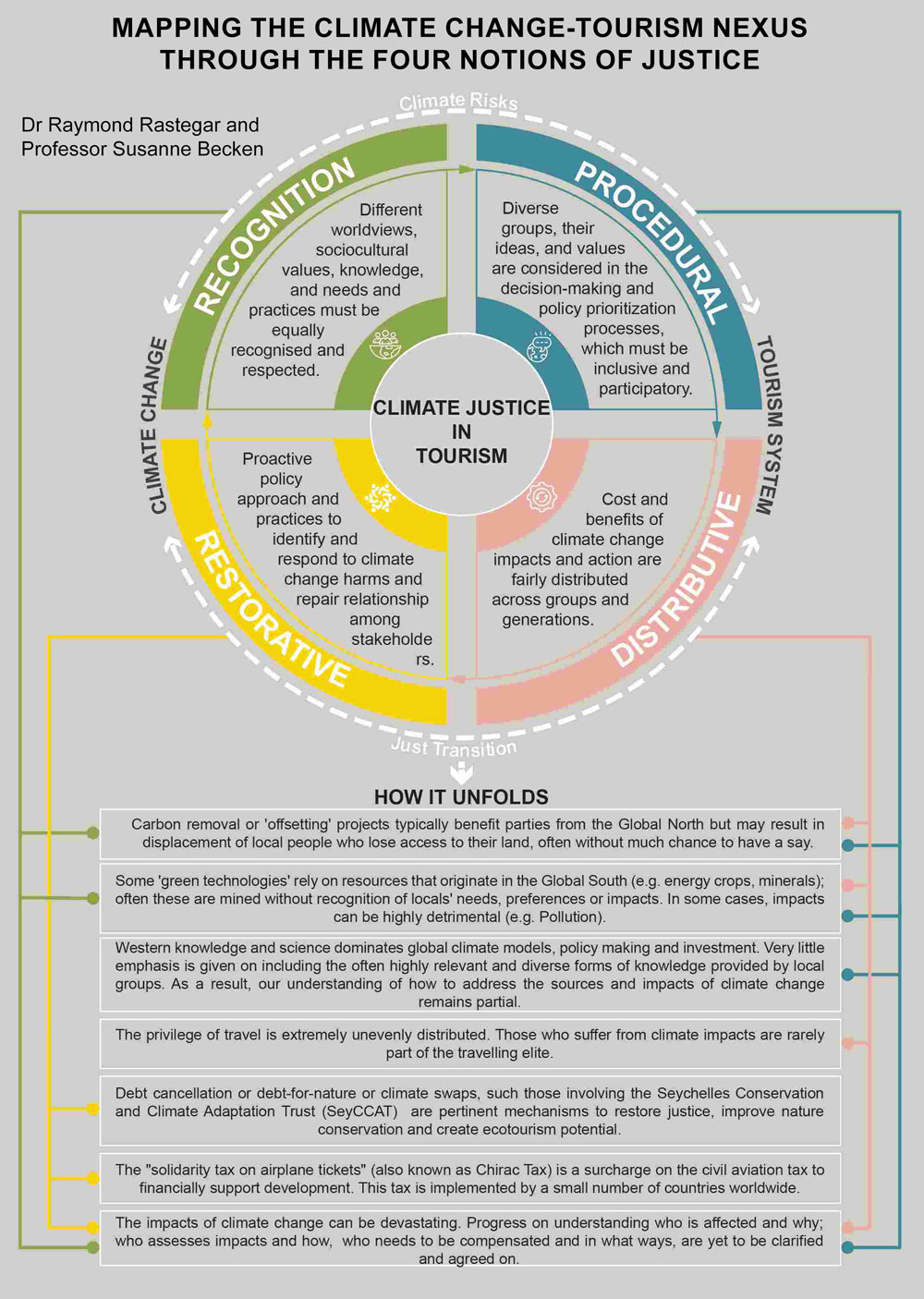
Climate justice seeks to ensure that climate action is equitable, inclusive, and responsive to the diverse ways in which people and ecosystems are affected by climate change.
Our research focuses on advancing justice within climate policy and practice, with an emphasis on fairness in decision-making, recognition of marginalised voices, and addressing both human and nonhuman vulnerabilities.
Climate justice priorities
- Net-zero transition and just sustainability transition
- Aviation and ethical considerations
- Justice in adaptation, mitigation, and decarbonisation
- Recognising diversity in climate policy and actions
- Climate change and nonhumans
- Participation and decision-making
- Equitable distribution of benefits and burdens
- Economic and noneconomic losses
- Climate change and Small Island Developing States (SIDS)
- Policy approach to identify and respond to climate change harms
- Climate justice movements
Core Team
Interdisciplinary Experts
Dr Freya-Higgins-Desbiolles
Impacts of tourism, tourism policy and planning, tourism sustainability, Indigenous tourism, and politics of tourism.
Dr Johanna Loehr
Tourism and climate change, sustainable tourism, systems thinking and South Pacific tourism.
Professor Lisa Ruhanen
Indigenous tourism, sustainable tourism and policy, planning and governance.
Professor Daniel Scott
Climate change and tourism/recreation, sustainable tourism, climate change impacts and adaptation.
Dr Ya-Yen Sun
Tourism sustainability, focusing on economic impacts and environmental footprinting.
Current projects
Extreme heat in cities: Co-developing Just Adaptation for urban tourism
This project addresses the urgent need for heat adaptation in cities as intensifying heatwaves threaten lives and economic productivity. It develops a measure to assess tourism-related heat hazards, examines pressures on city systems, and explores differing vulnerabilities among tourists and workers through global analysis and city case studies.
Just transitions in tourism: Navigating climate vulnerabilities
Tourism is increasingly vulnerable to climate change, yet adaptation in tourism destinations often overlooks equity and justice considerations, further exposing already marginalised communities to heightened risks. This project aims to critically examine and address these justice gaps by exploring how sustainability transitions in tourism can be made more inclusive, equitable, and responsive to the needs of vulnerable communities.
Governing climate risks
As climate hazards intensify and compound existing social vulnerabilities, understanding how justice is embedded in climate governance has become more urgent than ever. This project critically investigates how climate justice is conceptualised, operationalised, and embedded in national tourism and climate change policies across a diverse set of countries.
Project outputs
Book:
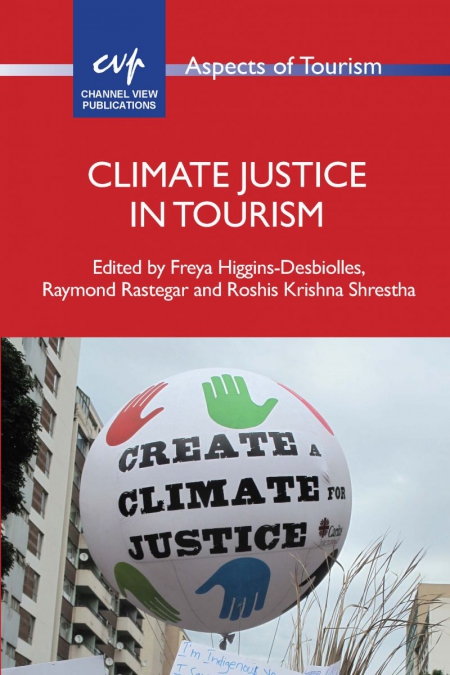 | Climate Justice in Tourism Freya Higgins-Desbiolles, Raymond Rastegar and Roshis Krishna Shrestha (eds) First comprehensive exploration of climate justice in tourism, critically examining how tourism is both a catalyst to the crisis but also a victim of its impacts. |
Journal articles:
- Justice and vulnerability in the face of global crises: Launching the annals of tourism research collection on justice in tourism
- Advancing climate justice in tourism: A critical evaluation of the TPCC Stocktake
- Regenerative justice and tourism: How can tourism go beyond restoration?
- Climate change and tourism transition: from cosmopolitan to local justice
- Embedding justice into climate policy and practice relevant to tourism
- Justice and ethics: Towards a new platform for tourism sustainability
- Justice and Tourism: Principles and Approaches for local-global sustainability and well-being
- Tourist aviation emissions: A problem of collective action.
- Towards a just sustainability transition in tourism: A multispecies justice perspective
- Tourism, global crises and justice: rethinking, redefining and reorienting tourism futures
- Transforming societies, transforming tourism: Sustainable tourism in times of change
Other:
PhD opportunities in climate justice and tourism
Are you passionate about advancing climate justice in the context of tourism?
Join a vibrant and interdisciplinary research community at the Griffith Institute for Tourism (GIFT), where we are committed to shaping more equitable, sustainable, and resilient tourism futures. Our academic team includes experienced supervisors with diverse expertise in climate justice, sustainability science, tourism governance, conservation, and environmental change. The Institute offers a dynamic PhD program with strong peer support, research training, and access to national and international networks. We encourage interdisciplinary and impact-oriented research that contributes to both academic knowledge and real-world transformation.
To explore potential supervision, please contact the academic whose research best aligns with your interests. If you are unsure who would be the most suitable supervisor, feel free to reach out directly to Dr Raymond Rastegar, who leads GIFT’s climate justice initiatives.